
Ticks are small, dark, oval-shaped arachnids. They need blood to grow and survive. Ticks used to be found mainly in forest and archipelago areas, but today they are found almost everywhere in Finland, except for the northernmost parts of Lapland.
If a tick has attached to your skin, it should be removed as soon as possible. Remove the tick using tick tweezers or regular tweezers by pulling it steadily upwards from as close to the skin as possible. Do not attempt to remove the tick using grease or insect repellent. If the tick is removed within 24 hours of the bite, the risk of contracting Lyme disease is generally quite low. For most people, a tick bite causes a small redness of about 2–3 centimeters, which is a common irritation reaction.
Ticks transmit two diseases: Lyme disease and tick-borne encephalitis (TBE). However, it is good to remember that not all ticks carry these diseases.
Lyme borreliosis (Lyme disease) is an illness caused by bacteria transmitted by ticks. Infection does not usually occur immediately, but often requires the tick to be attached to the skin for more than 24 hours. A redness wider than five centimetres that expands over time, appearing about a week after the bite, is a clear sign of the early stage of Lyme disease. Lyme disease can be treated with antibiotics.
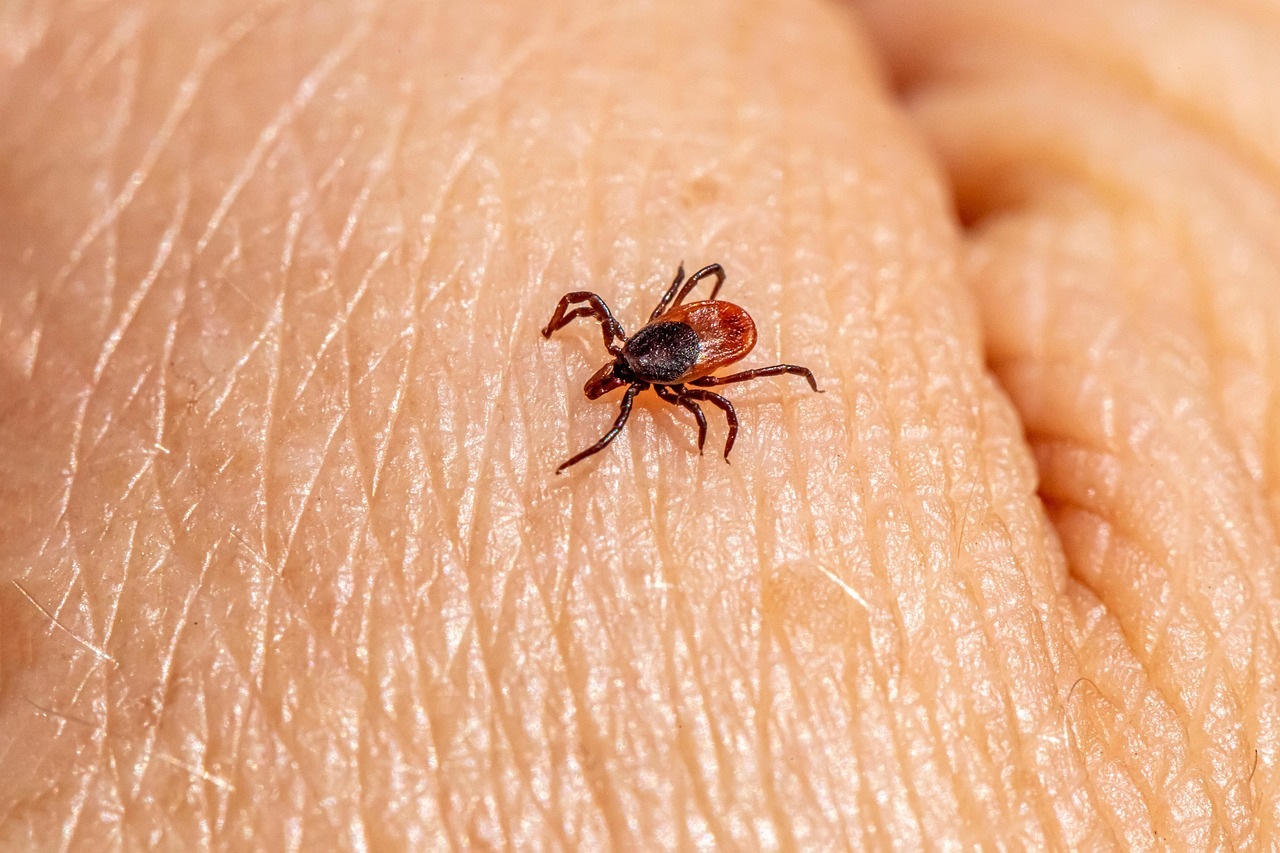
Tick-borne encephalitis (TBE) is a viral disease spread through tick bites. The TBE virus is transmitted within minutes right at the start of the bite. Symptoms of tick-borne encephalitis develop in about 10–30% of infected individuals. The first symptoms begin about 4–28 days after the bite. The disease usually progresses in two phases. The first phase typically begins within about a week of the bite. Symptoms include fever, vague malaise, and a general feeling of illness. This phase lasts on average less than a week, most often about 4–7 days, and for the majority of patients, the symptoms end there.
However, about 20–30 percent of those infected develop the second phase of the disease, actual encephalitis, after an asymptomatic period of about a week (3–21 days). At this stage, fever returns along with central nervous system symptoms such as headache, neck stiffness, sensitivity to light, and nausea. Additionally, neurological symptoms such as impaired consciousness, seizures, or paralysis may occur.
Many who contract actual encephalitis are left with long-term symptoms after the illness, and for about 2–10 percent, these can become permanent. Such symptoms include irritability, impaired memory and concentration, hearing damage, limb paralysis, and muscle weakness.
Protecting against and preventing ticks is important. When spending time in nature, especially in tick-prone areas, it is a good idea to protect yourself with clothing, such as long trousers and a long-sleeved shirt; it is recommended to tuck your trouser legs into your socks. Additionally, you should apply insect repellent to exposed skin.
It is a good idea to perform regular tick checks on your skin, especially after spending time in nature. When checking for ticks, be particularly thorough with your scalp, behind the ears, neck, armpits, groin area, back, and legs.
You can also protect yourself against tick-borne encephalitis (TBE) by getting the tick vaccine. Read more about tick vaccination at https://www.lahilaakarit.fi/kaikki-palvelut/punkkirokotus-eli-tbe-rokote. The vaccine protects only against tick-borne encephalitis (TBE), not Lyme disease, and it does not prevent ticks from attaching to the skin.
Read more:
https://www.potilaanlaakarilehti.fi/uutiset/perhanan-punkit-10-tarkeaa-faktaa/
https://www.terveyskirjasto.fi/dlk00063

Customer service
050 410 8629 (Kalasatama)
050 344 0000 (Soukka)
050 479 7800 (Tikkurila)
050 409 1801 (Leppävaara)
050 413 5576 (Itäkeskus)

